Brooklyn Army Terminal: From War to Work
At a Glance
- What
Brooklyn Army Terminal: a former U.S. Army supply and shipping base, now a working industrial campus with public waterfront spaces.
- Where
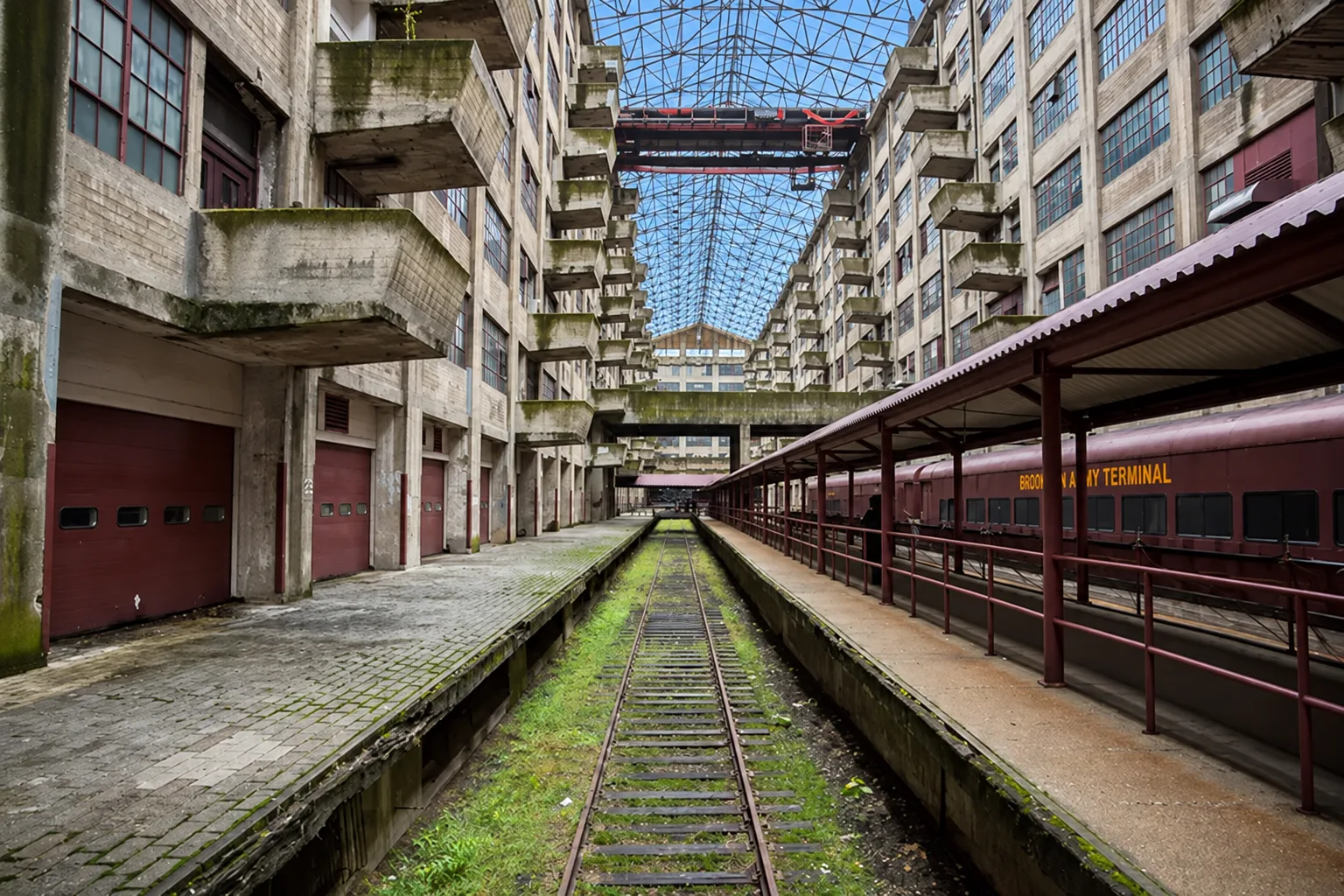
140 58th Street, Sunset Park, Brooklyn. The photographed atrium is in Building B.
- Built
1918–1919, during a military construction program begun in World War I.
- Architect
Cass Gilbert.
- Today
City-owned industrial campus managed by NYCEDC.
- Public access
Public spaces, including the atrium and waterfront: daily, sunrise to sunset.
- Getting there
N or R to 59th Street; B11 to 58th Street and First Avenue; B37 to 58th Street and Third Avenue; NYC Ferry to Sunset Park.
- Current developments
BATWorks opened its temporary home on April 15, 2026. The yearlong, free In Plain Sight public-art initiative opened June 4, 2026.
- Coverage
- Explore coverage
- Details
- What to Know
TheNakedNYC coverage

TheNakedNYC on YouTube: Brooklyn Army Terminal and Sunset Park.
What to Know
A Design for Moving Cargo
The projecting concrete platforms in Building B were loading balconies, not apartment terraces. Their staggered arrangement gave cargo handlers access to different warehouse floors. Freight trains entered the atrium below, where equipment moved goods between railcars and storage areas. The tracks, balconies and overhead steelwork make the original system unusually easy to read today.
Cass Gilbert designed the complex around the practical work of receiving, storing and shipping freight. Reinforced concrete, interconnected buildings and routes between warehouses and piers turned a large site into a coordinated loading operation. Its architectural drama comes from that working structure. Brooklyn Army Terminal: history and architecture; Turnstile Tours: Brooklyn Army Terminal walking tours.
Built for World War I
Construction began in 1918, when the Army urgently needed more capacity to send troops and supplies overseas. The initial complex was completed in 1919, after World War I had ended. It nevertheless remained useful for the military movements that followed.
The waterfront location mattered. The site had access to a deep-water shipping channel and connections to existing rail yards. Goods could arrive by train, move into warehouses and continue to ships without being hauled across the city between separate facilities. The National Park Service's engineering record describes warehouses, piers, rail tracks, bridges and tunnels as parts of one freight-handling plan. It also notes that eventual manufacturing use was considered in the original planning. National Park Service engineering record, held by the Library of Congress.
Soldiers and the Wartime Port
During World War II, Brooklyn Army Terminal served as headquarters for the New York Port of Embarkation. Military personnel and civilian workers handled the flow of troops and supplies through New York Harbor. Municipal Archives photographs document vehicles, weapons and ration cases at the base.
The port was a network of facilities around the harbor. Its troop and cargo totals covered a wider operation than Brooklyn Army Terminal alone. NYC Municipal Archives: Sunset Park and the port
The Aims of Prohibition
Prohibition grew out of a long temperance campaign. Its supporters argued that restricting alcohol would protect family income, reduce the damage caused by heavy drinking and improve public morality. Some employers supported the movement because they wanted a more disciplined workforce. Organizations including the Women's Christian Temperance Union and the Anti-Saloon League helped turn those arguments into political pressure.
Drinking initially declined, but enforcement proved difficult. Illegal production, smuggling and speakeasies continued to supply a market that the law had not eliminated. National Archives: the Volstead Act and temperance.
What the Law Banned
The 18th Amendment prohibited the manufacture, sale and transportation of intoxicating liquor for beverage purposes, as well as its import and export. It was ratified on January 16, 1919; national Prohibition began in January 1920. The Volstead Act supplied the enforcement framework.
The amendment targeted the liquor trade rather than consumption and possession themselves. Private drinking continued while federal agents pursued illegal production and distribution. National Archives: the 18th and 21st Amendments; Hoover Presidential Library: repeal and the Cullen-Harrison Act.
Confiscated Liquor on the Waterfront
During Prohibition, federal officers used the terminal to store confiscated liquor before disposal. Its military warehouses became part of an effort to interrupt the illegal alcohol trade.
Turnstile Tours’ history, drawing on contemporary newspapers, describes bottles being smashed at Pier 2 and liquor poured into the harbor. Officials tested an incinerator in March 1926. In September 1927, agents discovered metal buckets hanging beneath the pier to catch alcohol draining through its planks.
The incidents reveal another task behind enforcement: keeping seized stock from returning to circulation. NYC Municipal Archives: Sunset Park and the port Turnstile Tours: Prohibition at the terminal, with historical references
The Path to Repeal
President Franklin D. Roosevelt signed the Cullen-Harrison Act on March 22, 1933. It allowed the return of qualifying low-alcohol beer and wine; beer sales resumed under the new federal rules in April. This was a relaxation of Prohibition, not the repeal of the 18th Amendment.
National Prohibition ended on December 5, 1933, when the 21st Amendment was ratified. State alcohol controls continued. Turnstile's historical account reports that the terminal was still auctioning confiscated wine in December 1934. The legal change came faster than the job of clearing the government's stored stock. Hoover Presidential Library: repeal and the Cullen-Harrison Act; National Archives: the 18th and 21st Amendments; Turnstile Tours: Prohibition at the terminal, with historical references.
Elvis Presley’s Army Departure
On September 22, 1958, Elvis Presley departed Brooklyn Army Terminal for military service in West Germany aboard the USS Randall. A surviving Army press memorandum documents the departure. The Municipal Archives places his embarkation at Pier 4.
Presley left as a soldier aboard a troop transport. His journey was part of the terminal’s military work after World War II. Christie's: the terminal's 1958 Army press memorandum NYC Municipal Archives: Sunset Park and the port
From Military Base to Industry
The terminal closed as a military base in 1966, while other government and private uses continued afterward. New York City bought the property in 1981. NYCEDC began managing it in 1986.
The former warehouses became business premises, and parts of the waterfront opened to visitors. Industrial work remains central to the campus. Brooklyn Army Terminal: history and architecture
The Working Campus Today
In May 2026, NYCEDC reported more than 100 tenants and 3,500 jobs at Brooklyn Army Terminal. Four new tenants had leased more than 58,000 rentable square feet.
Audible Difference designs and installs audiovisual systems. EcoLogic Solutions develops cleaning products. GoLocker provides parcel lockers. Otto Nemenz International rents camera and lens equipment. Their businesses continue the campus’s role as a place for production and services. NYCEDC: May 14, 2026 tenant announcement
Climate Technology at BATWorks
BATWorks opened its temporary home at the terminal on April 15, 2026. NYCEDC, the Los Angeles Cleantech Incubator and Cambridge Innovation Center developed the initiative for climate-technology programming and workforce training, including opportunities for Sunset Park residents.
A permanent facility is planned for vacant space in Building A. NYCEDC scheduled its opening for 2028. The project brings technology development and training into the existing industrial campus. NYCEDC: April 15, 2026 BATWorks opening
Art Across the Waterfront
In Plain Sight is a free, yearlong public-art initiative at Brooklyn Army Terminal and the Brooklyn Wholesale Meat Market. It opened June 4, 2026. Debra Simon of Debra Simon Art Consulting curated it with NYCEDC and WXY architecture + urban design.
The announced artists and works are:
- Z Behl: Ancient Spat
- Elana Herzog: Pillars of Society
- Nathan Kensinger: Post Industrial Progression
- DB Lampman: We Are Swirling and Tethered
- Hyesu Lee: Shared Rhythms
- LOT office for architecture: In Praise of Shadows
- Avani Patel: Movement in Nature
- Sheila Pepe: Work and Rest on Land and Sea
- Yuya Saito: Echoes of the Current
- Jean Shin: Tidal Crossing
- Gabrielle Vitollo: Undercurrents
- Zhidong Zhang: Still Lives
The June announcement scheduled Shin’s installation for July. Several works were made on site using tenants’ materials and makerspaces. NYCEDC: In Plain Sight, June 4, 2026
The Neighborhood’s Namesake Park
The neighborhood and its namesake park are easy to confuse with the waterfront campus. Sunset Park itself lies between 41st and 44th Streets, and Fifth and Seventh Avenues. The hilltop overlooks Manhattan, the Statue of Liberty and New York Harbor.
Its pool opened on July 20, 1936, during New York's major WPA-era public-pool building program. That makes it another substantial public-work landmark in the neighborhood, although it had a recreational purpose rather than the terminal's military one. The city celebrated the pools' 90th anniversary in 2026. The 2026 outdoor swimming season ended September 13. NYC Parks: Sunset Park; NYC: the 1936 pools and the 2026 season.
A Century of Change
- 1918–1919: The Army's waterfront supply complex is built, with Cass Gilbert providing its architectural design.
- January 16, 1919: The 18th Amendment is ratified.
- 1920: National Prohibition begins; the terminal becomes a storage site for seized liquor during the era.
- March 1926: An incinerator is tested for destroying confiscated alcohol.
- September 1927: Agents discover collection buckets beneath a liquor-disposal pier.
- December 5, 1933: The 21st Amendment ends national Prohibition.
- July 20, 1936: Sunset Park's public pool opens.
- World War II: The terminal serves as headquarters of the wider New York Port of Embarkation.
- September 22, 1958: Elvis Presley leaves for Germany aboard a military transport.
- 1966: The terminal closes as a military base; other uses continue afterward.
- 1981: New York City purchases the property.
- 1986: NYCEDC's management of the campus begins.
- April 15, 2026: BATWorks opens its temporary home.
- May 14, 2026: NYCEDC announces four new terminal tenants.
- June 4, 2026: In Plain Sight opens.
- 2028, planned: The permanent BATWorks facility is scheduled to open.
Visiting the Waterfront
Building B’s atrium brings the rail tracks and loading balconies into one view. The waterfront promenade leads to Pier 4, whose north edge retains public access. These spaces belong to a campus where industrial tenants continue to work.
Pier 4 parking is listed from 6 a.m. to 11 p.m., subject to event restrictions and pier closures. Check the terminal’s visitor information and current transport service before travelling. Brooklyn Army Terminal: current visitor information